

Fannie Lou Hamer
The Unstoppable Voice of the Delta
In the mid-20th century, the American South was a landscape of systemic exclusion, where the law was often used as a fence rather than a shield. Amidst this, Fannie Lou Hamer emerged not from the halls of academia or the pulpits of established urban churches, but from the sun-scorched earth of the Mississippi Delta. Her significance lies in her authenticity; she was a woman who spoke the language of the people she represented because she lived their struggles every single day.
Hamer’s entry into the Civil Rights Movement was sparked by the fundamental realization that her disenfranchisement was not a personal failing, but a structural theft. When she attempted to register to vote in 1962, she was met with immediate retaliation. She was fired from the plantation where she had worked for nearly two decades and was later arrested and beaten so severely that she suffered permanent kidney damage and a limp. Yet, Hamer famously noted that the beating didn’t make her afraid; it made her more determined.
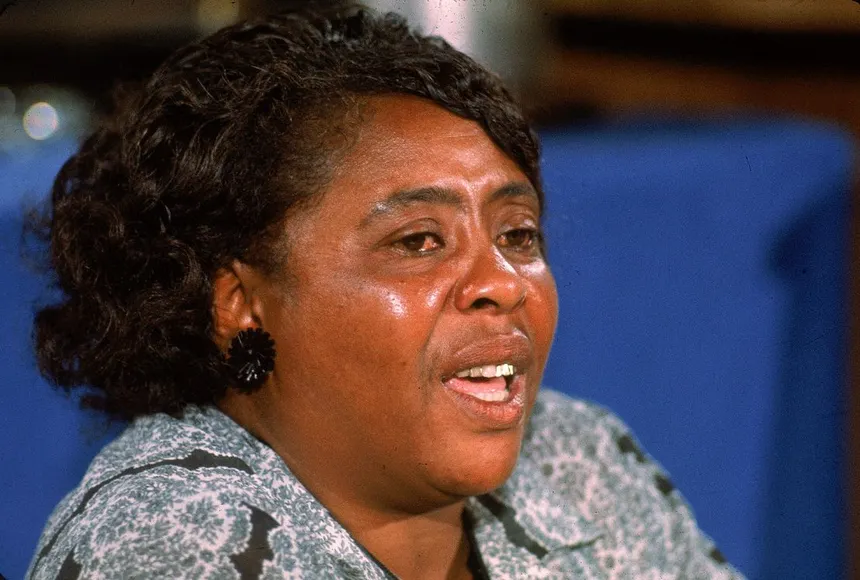
Her most iconic moment came during the 1964 Democratic National Convention in Atlantic City. Representing the Mississippi Freedom Democratic Party (MFDP), she sought to unseat the regular, segregationist delegation. In a televised testimony that was so powerful President Lyndon B. Johnson called an impromptu press conference just to divert the cameras away from her, she detailed the horrors she faced just for trying to be a citizen. “If the Freedom Democratic Party is not seated now,” she demanded, “I question America.” This was more than a political maneuver; it was a moral indictment of the United States. While the MFDP was not seated that year, her pressure led to a 1968 rule change that integrated the Mississippi delegation for good.
Beyond the ballot box, Hamer understood that political freedom was hollow without economic independence. She was a pioneer of “food justice,” launching the Freedom Farm Cooperative. She recognized that as long as Black families were dependent on white landowners for their very survival, their votes would always be under threat. By providing a way for people to grow their own food and own their own land, she was building a foundation for sustainable liberation.
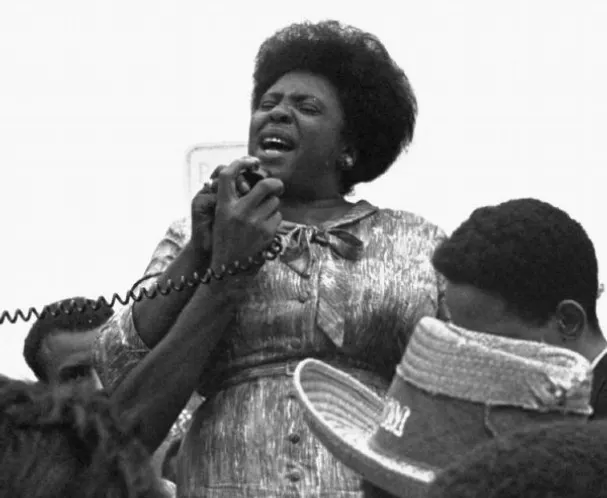
Today, Fannie Lou Hamer stands as a testament to the power of the “grassroots.” She reminded the world that the most marginalized members of society—the poor, the uneducated, the rural—are often the ones with the clearest vision of what justice should look like. Her voice, husky with the weight of her experiences but melodic with the hope of her faith, remains a guiding light for those still fighting against voter suppression and systemic inequality. She taught us that being “sick and tired” is not a state of defeat, but a catalyst for revolution.
Learn More
Fannie Lou Hamer’s life proves that political power does not require an elite pedigree; it requires an unbreakable will. She shattered the “respectability politics” of the era, proving that a sharecropper’s voice could be just as influential as a Senator’s. Her legacy laid the groundwork for the modern voting rights movement and intersectional advocacy, reminding us that “nobody’s free until everybody’s free.”