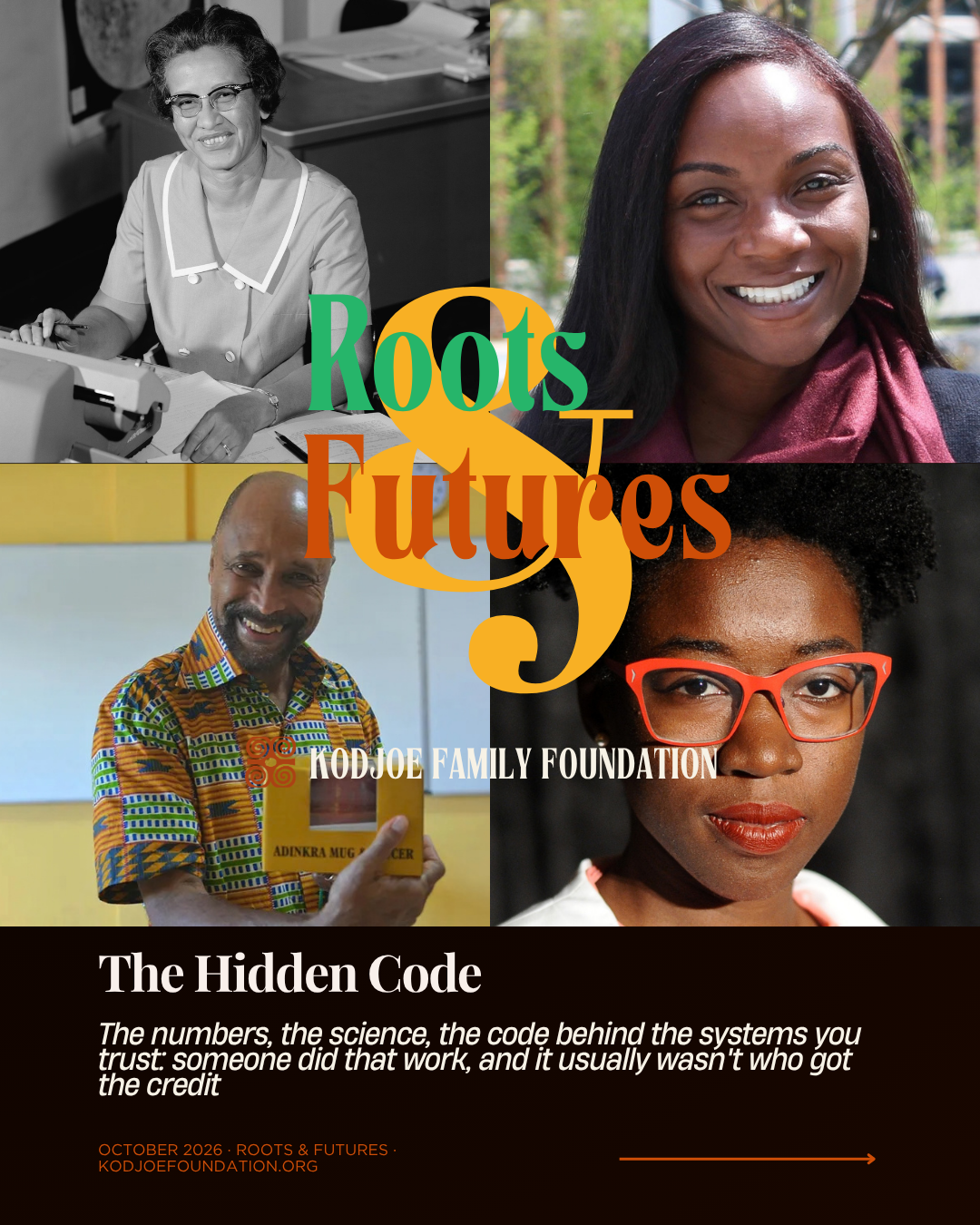
We were told the numbers, the science, the code were neutral. October’s hidden-code workers knew better: someone always has to write it, and someone always has to check it, whether the world remembers their name or not. From a segregated NASA computing pool in 1962 to an MIT lab in 2018, the labor behind science, medicine, and machines was never neutral. The credit went to the system. The work still has their names on it.
In 1962, before John Glenn would fly, NASA’s own machines needed a human check: mathematician Katherine Johnson, working inside Langley’s segregated West Computing pool, hand-verified the orbital trajectory a new electronic computer had already calculated. It took her a day and a half. Her numbers matched the machine’s. Glenn flew, and Johnson’s math went on to plot Apollo 11’s path to the moon and Apollo 13’s emergency return, almost entirely uncredited until a book and a film, sixty years later, finally carried her name.
In 1969, Clarence “Skip” Ellis became the first African American to earn a PhD in computer science, then spent his career building “groupware,” software that lets people work on the same thing at the same time. At a research lab called MCC, he pioneered the technique now called operational transformation, the invisible mechanism behind every shared document you have ever edited alongside someone else. Almost nobody who uses it knows his name.
Nearly sixty years after Johnson’s numbers went unnamed, Dr. Kizzmekia Corbett stood at the center of a different hidden calculation. As scientific lead on NIH’s Coronavirus Vaccines and Immunopathogenesis Team, her years of prior spike-protein research meant the first COVID-19 vaccine trial could begin just 66 days after the virus’s genetic sequence was released in January 2020, groundwork most of the public never learned existed until a pandemic made it urgent. Dr. Fauci said it plainly at a public event: the vaccine was developed by an African American woman, and that fact needed saying out loud.
In 2018, an MIT graduate student named Joy Buolamwini discovered that standard facial-detection software wouldn’t register her face, until she put on a plain white mask, which the system read instantly. That discovery became “Gender Shades,” a study that found error rates as high as 34.7% for darker-skinned women in commercial facial recognition systems, compared to under 1% for lighter-skinned men. IBM stopped developing facial recognition. Amazon paused police use of its own system. Buolamwini had turned an algorithm’s blind spot into something the whole industry had to see.
Whether it’s hand-calculated orbital math, the code behind a shared document, a genetic sequence, or a facial-recognition algorithm, someone wrote it, and someone’s name belongs on it. This month, we meet the people who did.


