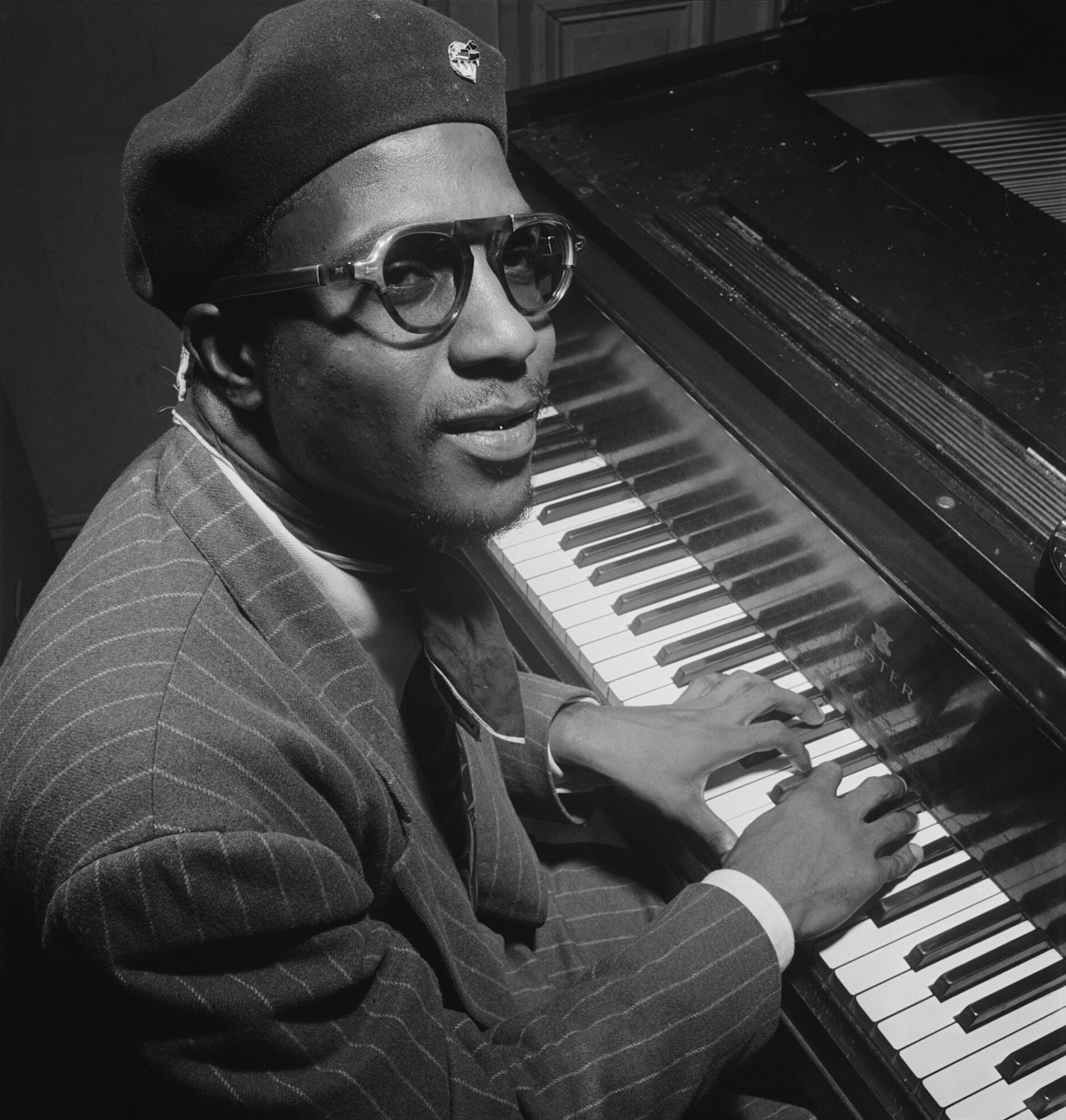
Thelonious Sphere Monk was born in Rocky Mount, North Carolina, in 1917, and moved with his family to Manhattan’s San Juan Hill neighborhood around age five. He started piano at nine, and by his early twenties, he was one of the house pianists at Harlem’s Minton’s Playhouse, where after-hours jam sessions with musicians including Dizzy Gillespie, Charlie Parker, and Kenny Clarke helped give birth to bebop.
Monk’s own style set him apart even within that innovation. His playing was percussive, angular, full of dissonant intervals and deliberate silences, a sharp break from the stride piano tradition he’d grown up around. Critics and audiences frequently didn’t know what to do with it. For much of his career, Monk’s music was treated as strange, even mistaken, rather than intentional, a reputation that only slowly gave way to recognition.
That recognition eventually arrived at a significant scale. In 1964, Time magazine put Monk on its cover, one of only a handful of jazz musicians to receive that honor, in a feature titled “The Loneliest Monk.” Compositions that once struck listeners as odd, “‘Round Midnight,” “Blue Monk,” “Straight, No Chaser,” became foundational jazz standards. Monk is now widely regarded as the second-most-recorded jazz composer in history, behind only Duke Ellington, despite a catalog of roughly 70 compositions compared to Ellington’s more than a thousand.
Monk withdrew from public performance in the mid-1970s, played his last major show at Carnegie Hall in March 1976, and spent his final years largely out of the public eye before his death in 1982.
November’s theme is the aesthetics of preservation, and Monk preserved something the mainstream initially refused: a sound built on the notes other musicians were taught to avoid. It took the world decades to catch up to what he’d already known was right.