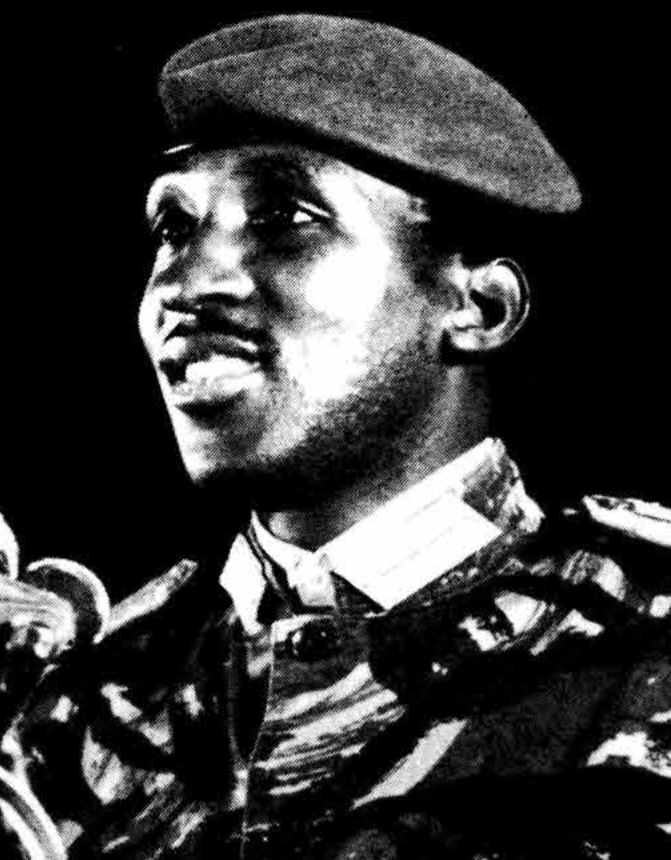
In October 1983, a 33-year-old military officer named Thomas Sankara became president of Upper Volta, one of the most impoverished nations on earth, a landlocked country in West Africa that the world had largely written off as an economic basket case. He had four years. He used every one of them.
The first thing he did was rename the country. Upper Volta, a colonial designation tied to a French river boundary, became Burkina Faso: “Land of Upright People.” The name change wasn’t symbolic theater. It was a declaration of a new frame. The people of Burkina Faso would build their country on their own terms, in their own language, with their own hands.
What followed was one of the most compressed social revolutions in modern history. Sankara redistributed agricultural land from feudal landlords to two million rural farmers, ending the tenant system that had kept peasants structurally indebted for generations. He launched a mass vaccination campaign that reached two million children against meningitis, yellow fever, and measles, an operation that health workers across the continent would study for decades. He planted ten million trees to fight desertification. He built roads and schools using volunteer labor. He drove Burkina Faso to food self-sufficiency in four years; a country that had imported grain was now growing its own.
On women’s rights, he moved faster than most Western nations would move for another generation. He banned female genital mutilation, outlawed forced marriages, and appointed women to government positions. He gave a speech on March 8, 1987, International Women’s Day, that remains one of the most rigorous analyses of patriarchy and economic exploitation ever delivered by a head of state. “The revolution cannot triumph without the emancipation of women,” he said. He meant it structurally, not rhetorically.
Then there was the debt.
When the World Bank and IMF extended their loans to African nations, the money came bundled with structural adjustment programs: governments had to slash social spending, privatize public services, and open their markets to foreign goods. Sankara understood what this meant. In July 1987, at a summit of the Organization of African Unity, he stood before his peers and called for a unified African front to refuse repayment. “Debt is a cleverly managed reconquest of Africa,” he said. He argued that the poor and exploited had no moral obligation to repay money to those who had built wealth on their extraction.
He was assassinated three months later, on October 15, 1987. He was 37 years old. The coup was led by his former ally Blaise Compaoré and is widely believed to have been backed by France and the Ivory Coast. After his death, Compaoré immediately reversed Sankara’s policies, accepted IMF conditions, and re-entered Burkina Faso into the debt system Sankara had tried to break.
What gets called “Africa’s Che Guevara” by those who want to make him romantically tragic was, in practice, something more disciplined: an administrator who happened to be a revolutionary. He wore only domestically produced cotton. He sold off the government fleet of Mercedes-Benz vehicles and replaced them with Renaults, the cheapest car sold in Burkina Faso. He refused air conditioning in his office because the citizens he served didn’t have it.
The question Sankara’s life poses isn’t whether radical transformation is possible. He proved that it is. The question is who benefits when those who attempt it are removed from the board, and what it takes to carry the work forward anyway.
The relay continues.