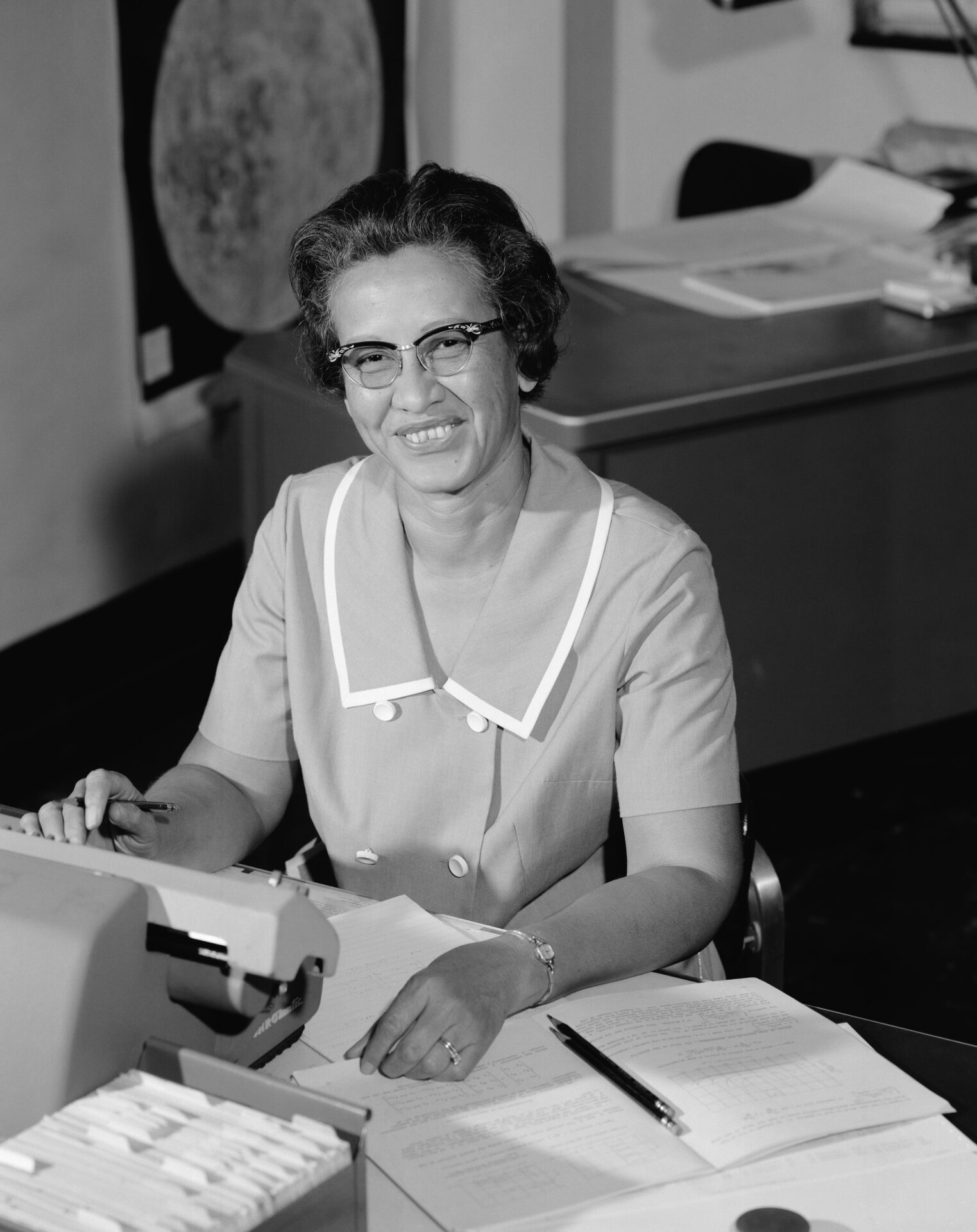
Katherine Coleman Johnson was born in White Sulphur Springs, West Virginia, in 1918, and by eighteen she’d graduated summa cum laude from West Virginia State College with a degree in mathematics and French. In 1953, she joined NACA (NASA’s predecessor) at Langley Research Center, hired into a pool of Black women mathematicians doing hand calculations under Jim Crow-era segregation, a “computing” workforce whose results routinely appeared in official reports under the names of the white male engineers they worked for.
Johnson’s calculations put Alan Shepard on America’s first human spaceflight in 1961. The following year, before John Glenn’s orbital mission, he made an unusual request: have Katherine Johnson personally re-verify, by hand, the trajectory numbers a new electronic computer had produced. It took her about a day and a half. Her figures matched the machine’s. Glenn flew.
She went on to work trajectory calculations for Apollo 11’s flight to the moon and the emergency return path for Apollo 13. Through most of it, her name stayed largely out of public view, one mathematician inside a system built to keep credit moving upward and outward, away from the women actually doing the math.
Recognition arrived late but unmistakably. Margot Lee Shetterly’s 2016 book “Hidden Figures” and its film adaptation introduced Johnson’s story to a wide audience for the first time. In 2015, President Obama awarded her the Presidential Medal of Freedom. In 2017, NASA named a computational research facility at Langley in her honor.
That’s October’s theme, in one career: code that runs everything and gets credited to no one, until someone insists on being seen. Johnson never stopped doing the work while she waited for the record to catch up. It eventually did.