

Sidney Jones was about eight years old when tennis found her.
"After the first lesson, that was it."
Eleven years later she took a gap year in Los Angeles to focus completely on tennis, with one plan: play college tennis.
But the story of Sidney's scholarship year isn't about how hard she works. That part was already in place. It's about what she decided to work on.
The mental game
Early in the year, the results weren't there. She'd played three tournaments and won one match.
She didn't blame her forehand or her serve. She named the real problem herself.
"I think that is due to my mental game, which is my biggest weakness and something that I've struggled with for a long time."
Then came a practice match she chose to film. She'd done a heavy workout the day before and was already sore. What mattered to her wasn't the score. It was how she framed her mind.
"I stayed extremely calm throughout the whole match, even though there were certain factors that could have disrupted my thinking."
And then, in her own words: "I'm really happy to see the progress that I've made, especially not only with my physical game, but with my mental game, because I feel like that's just as important in tennis."
That's the clip that matters. Not a trophy. The moment she saw the shift in herself and said it out loud.
What changed after
Later in the season she played the fourth and last match of a UTR league. It went to a final tiebreaker. She served it out.
It was her second win of the year, and she knew exactly what it meant, because, as she put it, the year before she didn't really win any.
"I was able to use everything that I learned mentally going into this new match and I played amazing."
The canvas
Here's what most people don't know about Sidney Jones: she paints.
One painting, made while she was still in school, is around six by five feet. She spent two to three months on it, painting in the mornings, at lunch, between classes.
"That's kind of like my second life other than tennis."
It's where she goes to take her mind off the stress of the sport. The same patience that rebuilt her mental game is the patience that stays with a canvas for three months.
What's next
The scholarship gave her real structure: multiple lessons every week, and a coach she could keep working with.
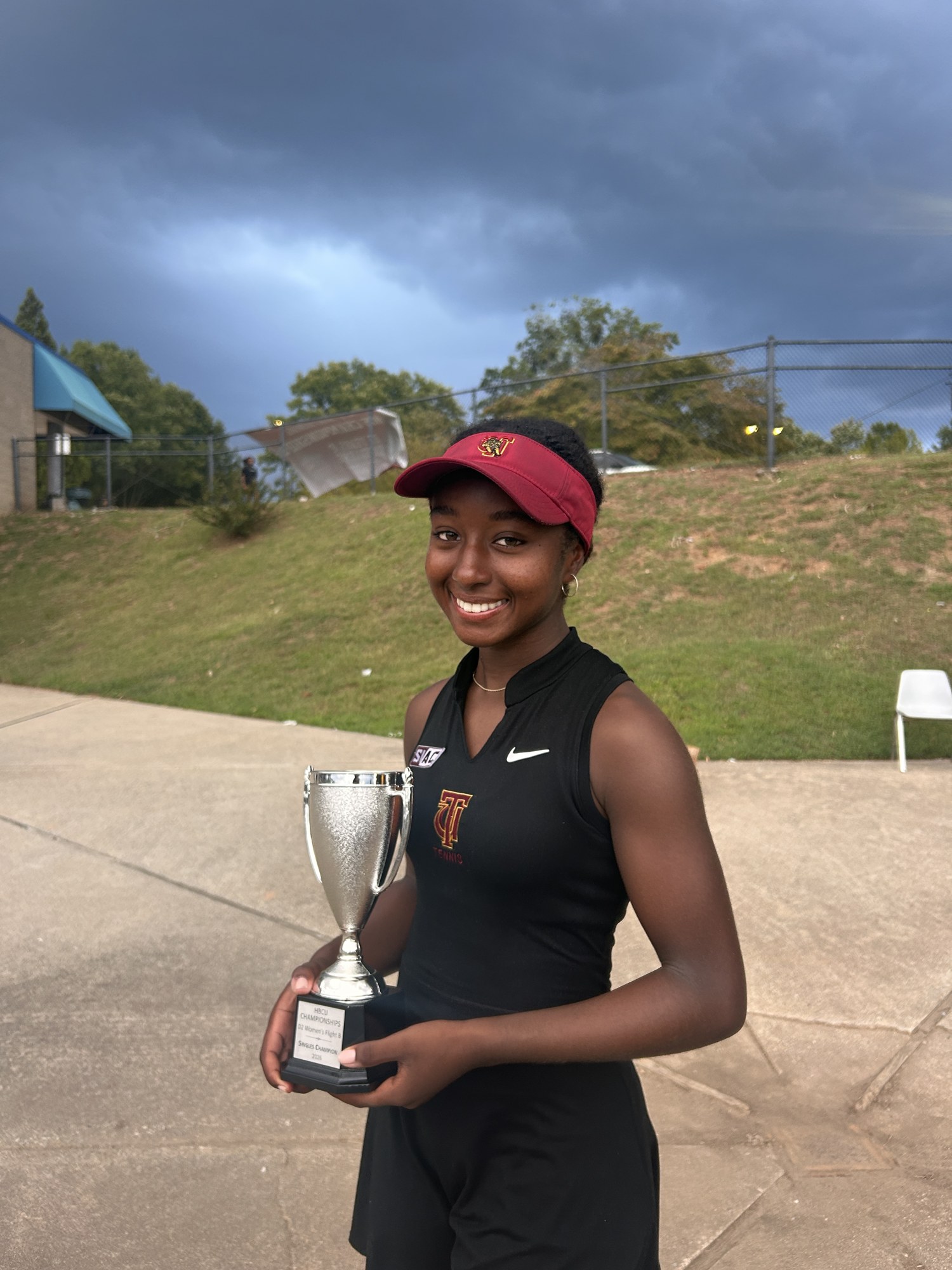
This summer she traveled to Tuskegee University to try out for the tennis team, and she was offered a full-ride scholarship to play.
She arrived at Tuskegee in August. Her next chapter starts there.
Sidney has also thanked the Jack and Jill of America Foundation, a Kodjoe Family Foundation partner, for contributing to her development as a player.
Next chapter: Champion in Her First Month at Tuskegee