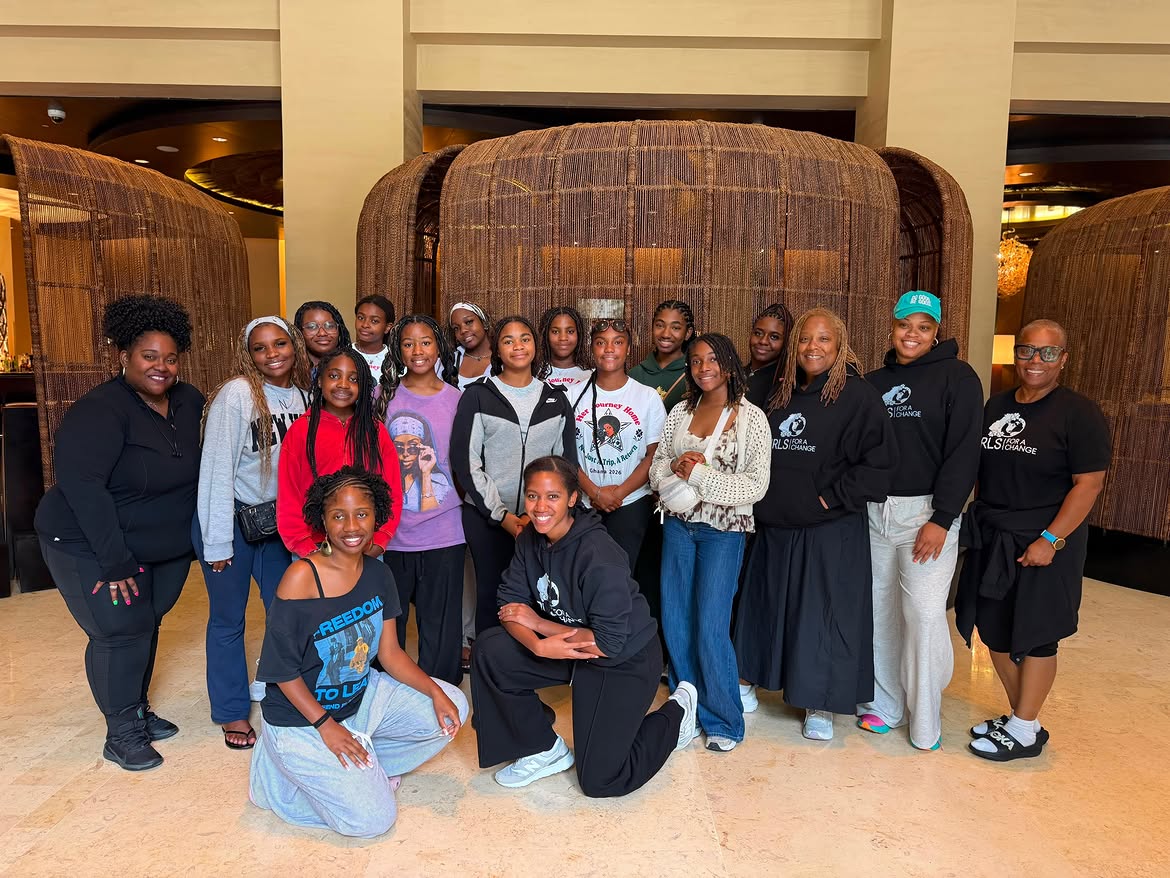
Her Journey Home was supposed to start with a bus ride to the airport. It started with a bus breaking down in Baltimore instead.
Girls For A Change’s Ghana 2026 delegation left Richmond by bus, headed for a flight out of JFK. A few hours in, a beeping sound that everyone assumed was nothing turned out to be an oil leak serious enough to strand the group on the side of the road. A new bus eventually came from Richmond. By the time it reached New York, a flash flood warning and police road closures had eaten the rest of the buffer. The group checked in as a group, together, only to be told they’d missed the cutoff by two minutes.
Two minutes, after a year of planning.
Girls For A Change put it plainly in their own public post the next day: a delegation of travelers was stranded at JFK, unable to reach Ghana after severe weather caused significant delays and a missed connection. What that post doesn’t fully capture is what was happening on the ground while it went out. Chaperones sleeping upright in airport chairs. A group of girls who, by every account from the adults around them, never stopped joking, dancing, and looking out for each other while the adults tried to hold it together. One line from the trip’s own journal says it better than any recap could: “Instead of breaking down or asking to be picked up, they displayed patience and joy beyond their years.”
The stranding turned into an unplanned test of exactly what the trip is supposed to be about. Her Journey Home exists to reconnect young Black girls with a history that was taken from their families and handed back to them as something unreachable. Getting knocked sideways by a bus, a flood, and two lost minutes and choosing not to fall apart over it isn’t a footnote to that story. It’s the same story, a day early.
Support poured in once Girls For A Change went public with what was happening: news coverage, fundraising, a wave of community response the group’s own account describes as “a whirlwind of support.” Not every response was kind. Some of it questioned whether the trip should have happened at all. Girls For A Change’s own framing draws the line clean: concern from the community is valid, but criticism that spreads misinformation or pressure to cancel isn’t help, it’s noise. The girls kept going.
They landed in Ghana. However many hours late, however far from the plan, they landed. First steps off the plane. Familiar Twi phrases from girls who’d clearly done their homework before the trip started. A welcome team waiting for them, a mix of Ghanaian and Black American media staff, exactly the kind of cross-diaspora meeting this whole program exists to create. One detail from the trip’s own account is worth sitting with: a scent in the air outside the airport that unlocked memories nobody in the group knew they still had. That’s not a travel detail. That’s the point of the entire trip, arriving somewhere and finding out your body already remembers it.
Boris said something close to this to the group before any of it happened, on the July 7 send-off call. “You are the descendants of superheroes,” he told them. “Sankofa means reigniting that superpower in you.” His own son said something similar after his own trip to Ghana, years earlier, four words Boris still repeats: “Daddy, I feel so light here.” Neither of them knew yet what it would take just to get these girls there. The words held up anyway.
That first night, before anyone could rest, the group watched a video message from home. Parents on a screen, sending pride and comfort across an ocean their daughters had just crossed, for many of them the first time anyone in their family had made that crossing at all. It undid a lot of what the previous two days had cost.
Kodjoe Family Foundation isn’t the one telling this story. Girls For A Change is, in their own words, through their own team’s cameras and their own girls’ voices. Full Circle is what this looks like in practice: not KFF producing content about the diaspora, but standing behind an organization that’s already doing the work of reconnecting one, and making sure more people see it.
The trip continues through the rest of July. What comes home with these girls, literally and in every other sense, is still being written.
To support the Journey, Donate here.